


Share
chapter one 1960’s
by keith waldegrave
I never consciously wanted to be a photographer, it happened rather by accident. I was 17 years old and about to leave school with no clue about what I might do? A degree of skill in art and technical drawing, probably embedded in my genes, suggested maybe a career in a drawing office but fate intervened at the eleventh hour. I responded to an ad in the local paper and I landed a job as a trainee photographer with the Kentish Express in Ashford, my hometown.

The paper’s photographic department was what, I imagine, must once have been a first floor flat now above the garage where the delivery vans were housed. It was pretty squalid. The room where we developed films especially so. This was where we made tea or heated up baked beans for our lunch on a gas ring which also doubled as the means for drying our films hanging from a washing line close by. The other rooms were a basic darkroom for printing, a ‘sitting room’ cum occasional studio and a finishing room where we trimmed and glazed prints and stored negatives.
It was the usual fare for a local weekly newspaper. Village fetes, flower shows, Rotary Club dinners and amateur dramatic theatre productions etc., but applying a little creativity was the challenge. I was fortunate to have a talented chief photographer, ‘Shad’, Denis Shadbolt (he later changed his name to Shadwell!). He was full of bullshit but I certainly learned a lot from him. His mantra was to always shoot with available light. Flash as a last resort but even then preferably bounced off a wall or ceiling to give diffused light (I subsequently worked with a guy who developed a technique for bouncing flash off the top of his bald head!). Never direct flash if it could be avoided.
The company’s camera kit was truly archaic. I was given a museum piece made in London at the beginning of the twentieth century. A VN (Van Neck) press plate camera in the first instance and later a Speed Graphic both using 9 x 12 cm glass plates. The VN was very basic with no focussing aid and both cameras were extremely slow to use since you had to insert a plate (preloaded in it’s holder) cock the shutter, remove the darkslide before making your single exposure, return the darkslide, remove the holder and then repeat for each picture. I was laborious but very good discipline and certainly made you think carefully about making every exposure count.
I graduated to the heavy Speed Graphic with it’s equally heavy glass plates and six months into my apprenticeship thus equipped I took the train from home in Ashford to Herne Hill velodrome in south London for the 1963 Good Friday meeting.
At this point in my life I was a spotty teenage time-trialist. Cycling, my all-consuming passion, was now threatened by the erratic, unpredictable working life of a press photographer – not to mention being led astray by seasoned hacks and the discovery of girls and beer!
The most famous British cyclist at this time was Tommy Simpson who was riding in a motor-paced event at the Herne Hill track. I managed a pretty fine picture from that day considering my inexperience and six glass plates still survive.
‘Shad’ used his own Rolleiflex camera as did the only other photographer. There was no suggestion of being provided with more modern equipment. If I wanted anything better I would have to buy it myself. A twin lens reflex was generally the preferred camera at the time. I bought the only camera of it’s type I could afford, a Semflex, the French made poor man’s Rollei and later upgraded to the entry level Rollei T. But at least I was now using 120mm film both easier to load into the camera and to process. Twelve shots on a roll. What a joy!

The early 60s were exciting times for a teenager after the deprivation of the post war years. Things were really starting to look up. Music and the emergence of rock n roll, America soul and R&B were hugely important to me and my school friends and the easy access to artists, often relatively unknown ones, from the States.
I put my newly acquired Rolleiflex to good use at Tofts night club in Folkestone shooting Little Richard in action just a few feet away. No heavy security to make life difficult. I filled the frame and bounced flash off the ceiling showing the beads of perspiration on his brow as he sang “Good Golly Miss Molly”. Another picture from that era I’m quite proud of.
The paper paid for my driving lessons before letting me loose in the company’s red, white and black “Kentish Express” liveried vans around the Kent countryside. They were used twice weekly for night time distribution of the two titles produce by the KE. The rest of the time they were driven by reporters and photographers unladen. Light and none too stable, especially in the hands of the young and reckless, they were sometimes used to transport beer and firewood for beach barbecues occasionally ending up in a ditch on Romney Marsh.
A picture I’m most proud of from my KE days is James Bond’s Aston Martin DB5 from the film ‘Goldfinger’. Following the film’s promotional tour of Europe in 1965 it was flown into Ferryfield Airport at Lydd. The DB5’s smokescreen generating device was kicked into action for a dramatic photocall. The picture ran across a half page in that week’s paper.

A year later at the end of my three-year apprenticeship I was off. I always knew I’d leave as soon as I could. I did! My escalating wanderlust and my embryonic photographic career coincided and evolved. I would subsequently travel the world as a professional photographer for the rest of my working life.
In the meantime I had been seduced by David Bailey, the enfant terrible of 60s fashion photography and his endorsement of the Asahi Pentax 35mm single lens reflex. The “Just hold a Pentax” ad hit the spot. It did, indeed, feel like you could create magic with it. I bought myself a second hand S1A but was still clinging on to the Rollei for the excellent quality produced by two-and-a- quarter square.

I resigned in the summer of 1966 packed my Pentax, with wide angle and short telephoto lenses and the Rollei and spent two months hitch-hiking around Europe with my old school friend Steve Richards. A four-thousand mile road trip in other people’s cars. Then a brief spell with the opposition Kent Messenger, before another serendipitous moment led me to the soon-to-be-launched Evening Echo based in Hemel Hempstead and another staff job.
Not for the first time in my career I found myself working for a newspaper that didn’t, as yet, exist. The Echo and it’s sister paper, the Evening Post, were new and exciting newspapers attracting a young and creative workforce. Clean web offset reproduction and creative picture presentation in a broadsheet paper were both stimulating and satisfying for an ambitious photographer. We were actively encouraged to think ‘outside the box’ and produce the most imaginative pictures.
It was a similar menu to a weekly paper but a step up and more intense with a daily deadline six days a week. Everything was that bit more professional. Each photographer was issued with their own kit. A Canon FT QL 35mm SLR with 35mm, 50mm, 135 mm lenses and a Mecablitz 45 CL-4 flashgun. There was also a 400 mm Novoflex telephoto lens with it’s pistol-grip focussing for those Watford FC’s matches we covered both home and away, travelling all over the country and an off-season friendly tour to Malta too.

I now drove a Vauxhall Viva, from a pool of cars at our disposal, to my various assignments around south west Hertfordshire. No longer an Austin A55 van with nothing in the back but my camera bag. Me and my colleagues were mostly in our early twenties but no less reckless!
A large number of showbiz personalities lived in Hertfordshire with its easy access to London’s TV studios and theatre venues and film studios at Elstree. They were often willing to oblige a local paper with an interview and pictures. In addition to local news stories our features assignments often took us to places outside our circulation area including the occasional foreign assignment.
In the three years I worked for the Kentish Express I can barely recall any story I covered relating to the sea, shipping or anything remotely nautical despite our circulation area covering most of the county’s 350 mile coastline. Then during my time at the Echo in Hertfordshire, a landlocked county, I covered three Channel swims. Kevin Murphy was a journalist colleague on the Echo and his marathon 36 hour two-way swim was probably the
most memorable. I spent a lot of time in the water with him shooting on an underwater camera. He subsequently swam the channel 34 times!
It was another channel swim in the summer of 1969, however, which provided one of my favourite pictures from Echo days. Elaine Gray’s attempt came to an end mid-channel but not before a bizarre mid-ocean argument with her official observer. They both trod water for what seemed like an hour while I swam round them shooting pictures on an underwater camera. A channel ferry passing close by provided a dramatic backdrop. Unfortunately, Elaine grew too cold to continue and despite having been on schedule for a record-breaking crossing she gave up.
As the 60s gave way to the 70s I knew it was only a matter of time before my wanderlust got the better of me. I was enjoying life on the Echo but I was getting my taste of adventure in my own time. I drove to Istanbul through Communist Hungary and Bulgaria, and back, for a two-week holiday with like-minded friends.
On another occasion, a long-haul road trip across France, Spain and through the Atlas Mountains in Morocco. Somewhere near Ouarzazate on the edge of the Sahara while photographing a nomadic Berber family we were invited to share their cous-cous from a communal pot – and just the one spoon!

This was a dummy run in my VW Combi and a taste of the sort of adventures I hoped to experience on my overland trip across Asia in the not too distant future. It would come to pass in the winter of 1973/74.
chapter two 1970’s
The Echo and Post both proved to be stepping stones to Fleet Street. A lot of talent from both titles took that route. I had no such ambitions at this stage, it was all about seeing as much of the world as I could. I circled the globe twice in the next decade.
I resigned and headed east on the overland hippy trail to Kathmandu. For various reasons my plan to travel independently in my VW Combi van went pear shaped. I left the VW with a friend to sell on my behalf and bought a bus ticket on a 1953 vintage Bristol coach to Kathmandu with an extraordinary mixed bunch of thirty five passengers. Some I would never see again, thank God, others become life-long friends.
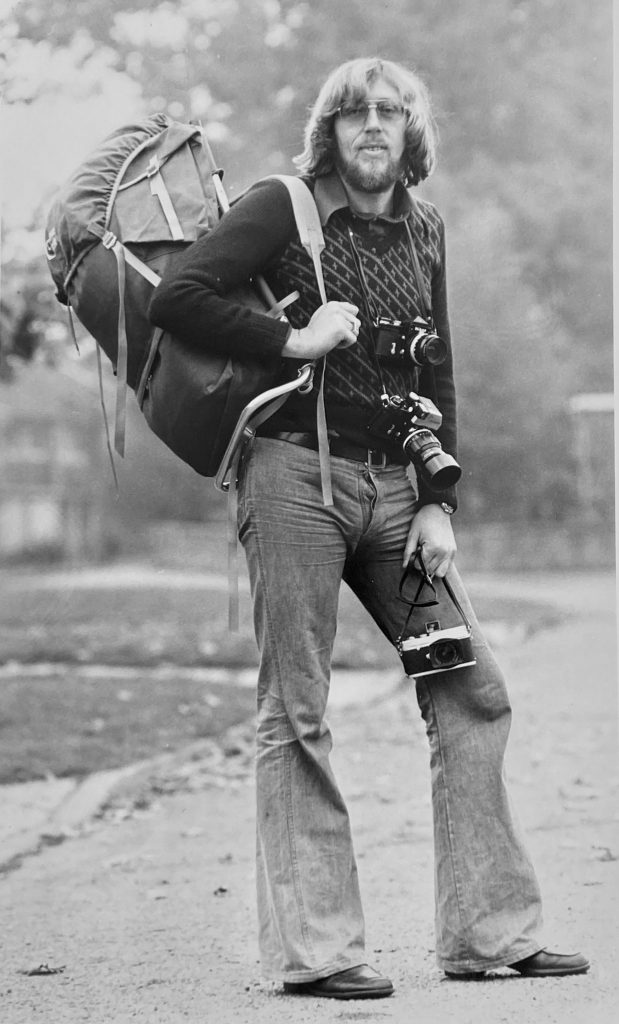
Swagman Tours’ Asian Greyhound camping tour was leaving London conveniently late in the year for me to join. Rather too late as it transpired. By the time we reached Turkey we went from swimming in the sea in the afternoon to waking the following morning with snow on the tents. Somewhere around Lake Van in the east it was minus 26 degrees and truck drivers were lighting fires under their fuel tanks to thaw out the diesel!
Our vintage bus proved unreliable. Dirty fuel caused blockages with the vehicle spluttering to a halt at the most inconvenient times. Once in deep snow in eastern Turkey and again in Baluchistan, a region notorious for unwary foreigners vulnerable to kidnapping, with all 36 passengers attempting to push a bus up a mountain in the middle of the night. Pink Floyd’s ‘Dark Side of the Moon’ blaring from the bus’s sound system made for a totally surreal experience.
In the foothills of the Himalayas, on the last leg up to Kathmandu, Tibetan refugees wandered barefoot in the ice and snow. I was craving some warmth by now and flying into the tropical heat of Bangkok was perfect. We hitch-hiked through Thailand and Malaysia to Singapore.
In preparation for my arrival in Singapore a Thai barber in Chiang Mai transformed me from hairy hippy to Buddhist monk. Anyone with hair of a certain length was being denied entry at this time on the orders of prime minister Lee Kuan Yew. It was nail-bitingly touch-and-go at this point and I was mightily relieved to be allowed in and finally receive the proceeds from the sale of my VW back in UK. I’d been down my last twenty bucks but now I could at least afford to eat!
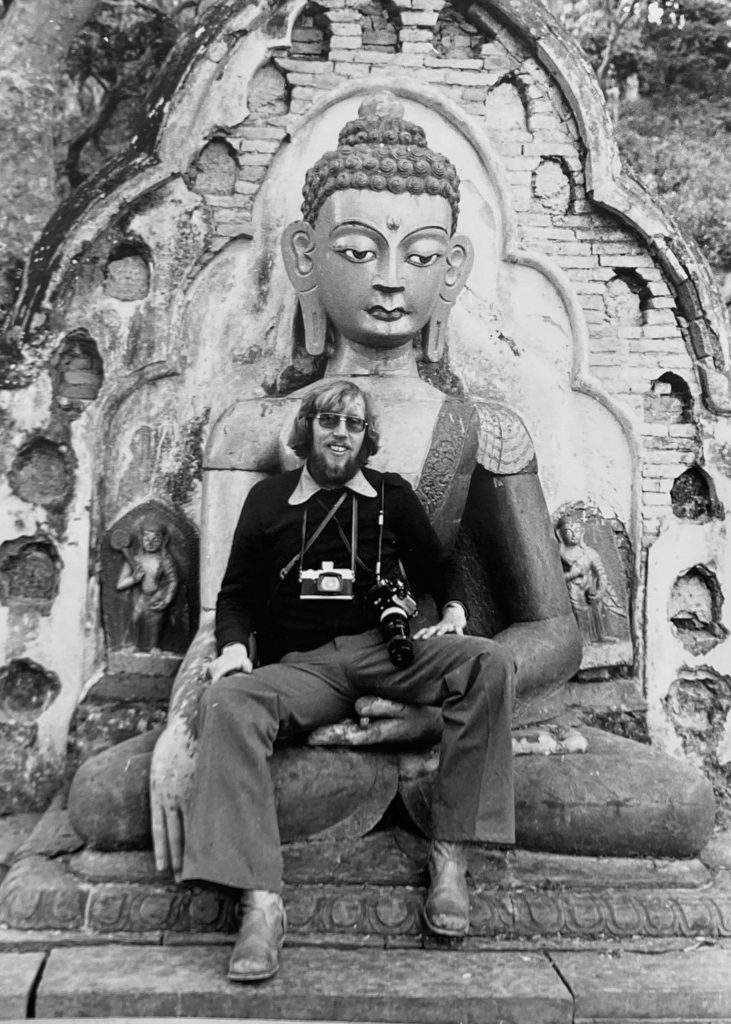
I travelled with another guy from the bus trip making our way through Indonesia, island hopping through Sumatra, Java and Bali. The three day, non-stop bus trip through the Sumatran rain forest was a real adventure. At one point we broke down in the middle of the night. Everyone was out of the bus when a tiger came padding along the track in our direction! The driver flashed the bus headlights and it took off into the bush. Riding public transport and mixing with the locals made for great pictures. I was in my element.
Things unravelled when I eventually flew into Darwin to find most of Australia’s Northern Territory flooded. Absolutely nothing was moving by road. So much for my prepaid bus ticket to Sydney! After much soul-searching I very reluctantly pawned my Nikons to buy an air ticket. It was either that or stay in Darwin hoping to find work while waiting for NT to dry out. Darwin’s pawnbrokers had no qualms about taking advantage of desperate travellers like me and needless to say I got a very poor deal. However, I flew on to Auckland and walked straight into a staff job on the New Zealand Herald. One of the country’s premier titles.
Fortunately the Herald kitted me out with the latest Nikon equipment and replacing my own cameras became my first priority.
New Zealand in the early 70s was not unlike Britain in the immediate post war period two decades earlier. Almost puritanical in some ways but at least they spoke English and I made life-long friends and worked with some talented journalists and photographers on the Herald. The workload was a touch parochial and not dissimilar to working for a weekly paper in UK.
My social life took a massive upturn. Home was a multi-roomed, weatherboard mansion populated by a bunch of party-loving twenty-something-year-olds in the upmarket suburb of Remuera. We were effectively hand-picked by the manager of an accommodation agency in Auckland who she thought might gel. It seemed to work pretty well and we had a ball.
In the run up to Papua New Guinea’s independence celebrations in 1975. I negotiated a deal with Air Pacific who agreed to let me ‘work my passage’ island hopping from Auckland via Tonga, Fiji, New Hebrides (now Vanuatu) and the Solomon Islands to Port Moresby in exchange for pictures of their aircraft and various destinations along the way.
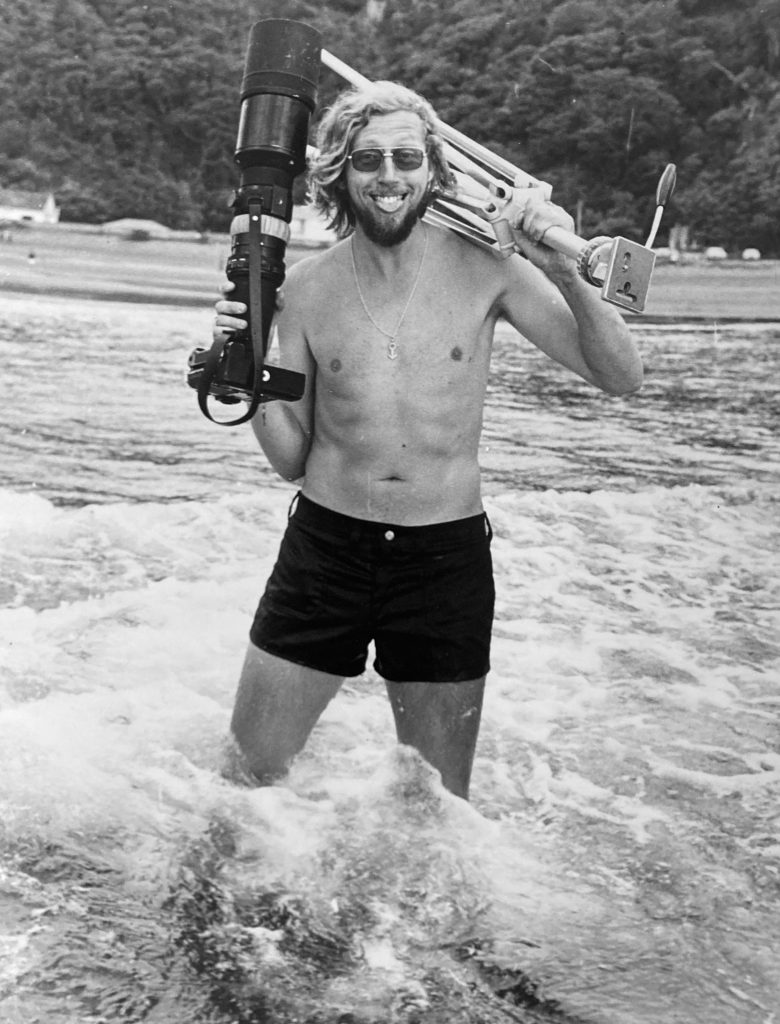
Representing the Queen, Prince Charles toured the country meeting the most colourful photogenic people imaginable. Exotic, scantily-clad, bare-breasted women and, frankly, downright scary tribesmen with bones through their noses. Up on the Highlands Highway near Mount Hagen a local dignitary’s welcome address in an incomprehensible local tongue prompted a pure Goon Show response from the Prince. He was a big fan of the show at the time and in his best Peter Sellers impression of Hercules Grytpype-Thynne, the Prince responded with, “Thank you for those few kind words”. I fell about laughing but the largely Aussie press pack didn’t get the joke.
I worked for the Herald for two years before heading off yet again. South America had long been on my radar and another young photographer colleague with similar ambitions was keen to travel with me. Rob Taggart had become a firm friend and we left Auckland on New Year’s Eve 1976 and flew to Tahiti. Crossing the Dateline brought us back into January 1st for a second time. Two new years for the price of one! Our next island stopover en route to Chile took us to Easter Island and the extraordinary and mysterious Moai (statues) where we stayed for a week.
On arrival in Santiago we turned right and south to Patagonia. The Moreno Glacier, Tierra del Fuego, Ushuaia then back north to Buenos Aires. Some of the longer journeys we flew with LADE, the government owned airline operated by the Argentine Air Force. Quicker and actually cheaper than long, tedious bum-numbing journeys by bus but operated in a rather capricious manner. It could prove unreliable and chaotic.
Sky high inflation in Argentina had us living like kings. An aperitif, steak, salad and a bottle of fine Malbec for a dollar fifty! How we missed all that when we crossed into Brazil where it was endless rice and beans and little else for the same money.
The Iguacu Falls then Salvador in Bahia for Carnival. Rio is for watching, Salvador is for participating in the street with everyone else. We adopted a rhythmic, swaying shuffle and simply didn’t walk any other way for days! Then we back tracked to Rio and into Paraguay. Way too many extraordinary adventures to relate here but sadly culminating in me losing my passport, airline tickets, travellers cheques (What are they? Just Google it!) and a wad of cash closely followed by devastating news of my father’s death in England.
I flew home leaving Rob to continue with various others met along the way before he arrived in London a few months later.
Returning home to my poor widowed mother after two years away was difficult. The taxi ride from the railway station disorientating. Ashford, my hometown had been redeveloped in alarming fashion while I’d been away. Entire streets of houses, homes of friends, had been replaced by a ring road. I had little money and no job but I did have friends who helped out with the use of a car. I started picking up freelance jobs for the Sun, mainly, and generated my own picture ideas which I sold on. Scrappy and irregular but infinitely easier and more profitable than today. I eventually bought a cheap car and moved into a flat in Maida Vale with the newly arrived Rob and, coincidentally, two fun Kiwi sisters who we knew from Auckland.
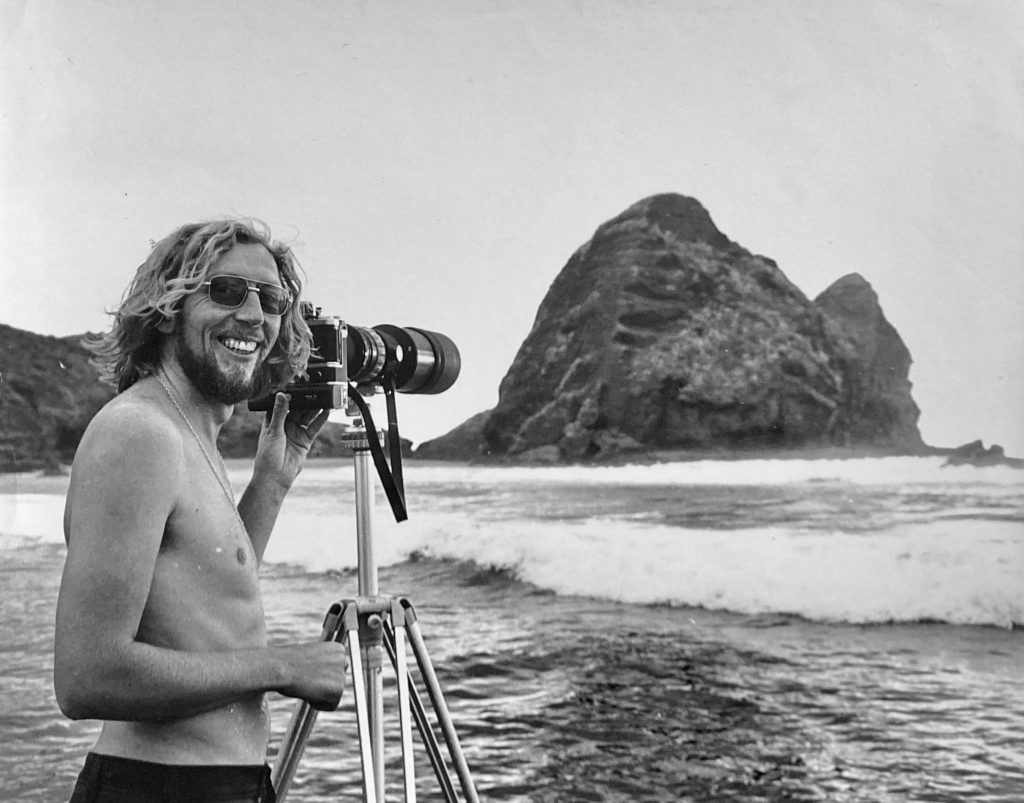
I was doing OK but there was the unresolved issue of my relationship with my Kiwi girlfriend back in NZ. Was I going to return to Auckland or was she going to sacrifice her recently acquired dream job as an air hostess with Air New Zealand to join me in London for an ongoing unpredictable future in England?
February 1977 and I felt it was me that had least to lose and decided to return to New Zealand. In little more a year I was more or less back where I’d started. I had no job and unlikely to be lucky enough to land on my feet second time around as I had when I’d first arrived in NZ.
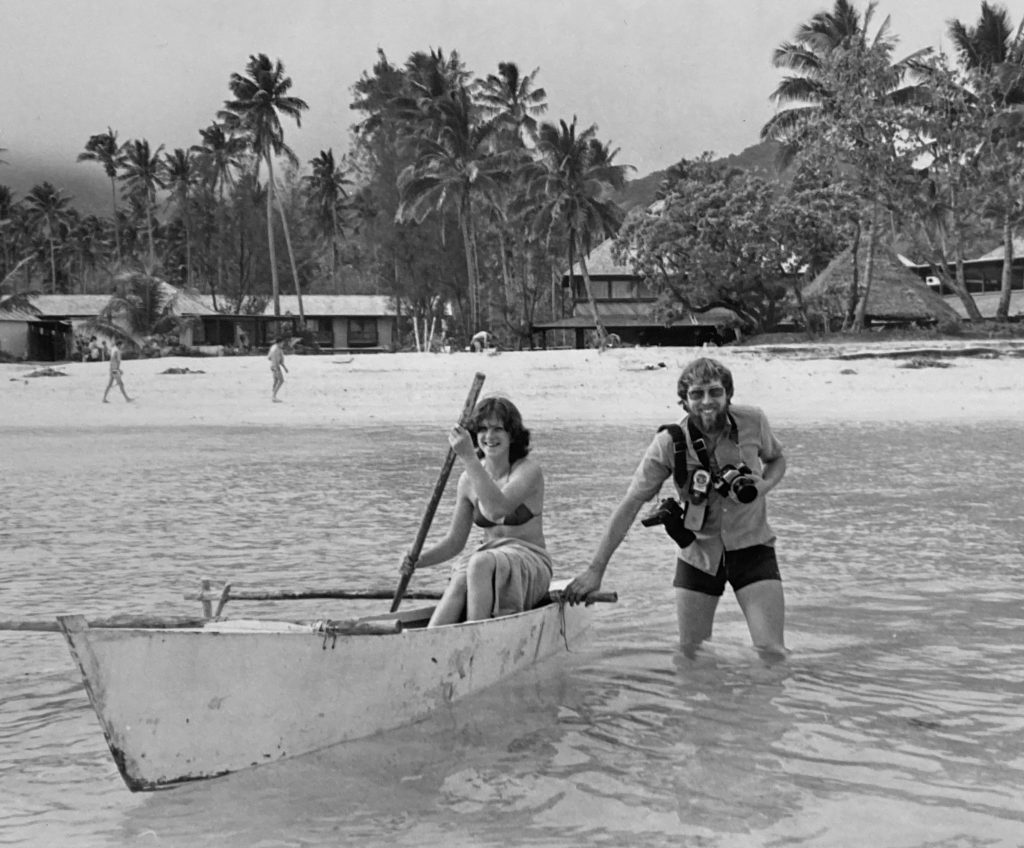
Freelancing in Auckland was very different from UK with it’s numerous daily newspapers. I was now working mostly for public relations agencies and company magazines. There were the occasional more interesting jobs. Air New Zealand’s inflight magazine and Travelog travel trade magazine had me flying to more of the Pacific’s beautiful islands.
Following a brief business partnership with another Auckland based, madcap photographer which went rather pear-shaped, my personal life unravelled. More stupidity on my part than anything else but Sydney seemed to offer more possibilities for press work. I felt it might be a good compromise. It was tried and tested ground by others I knew who taken that route and I wasn’t yet ready to return to UK.
I stayed in Sydney for a year living in a modern house with a harbour view in Cremorne a few minutes’ walk from Milsons Point. My daily commute for a shift on ‘The Australian’ started with ten-minute ferry ride across the harbour to Circular Quay. What an uplifting way to start the day!
My life in Sydney was totally hedonistic. Much of it in an alcoholic haze. Mid-week would find me listening to jazz at The Basement or washing down a barbequed steak with a fine Aussie red at The Oaks in Neutral Bay. A guy who paid me a retainer to shoot pictures for his audio-visual company would meet me for lunch, talk work for ten minutes, and we’d then finish a fine meal with a shared bottle of port! Sunday afternoons at ‘Louis at the Loo’ (Wooloomooloo) listening to al fresco jazz where for some unfathomable reason it seemed a good idea to drink black velvet in the scorching sun.
It really couldn’t go on like this. I felt I had to return to London and re boot my potential Fleet Street career.
I packed and returned to London. Again, not straight home but time with friends in San Diego, Fort Lauderdale and the Bahamas. In LA I picked up a car and delivered it (via the Grand Canyon and New Orleans) to it’s owner in Florida. A solo drive across the States in a free car, I merely had to pay for gas and oil.
I was invited to stay with friends of friends in the Bahamas. I would be flown to Freeport by someone who proved to be a serious ne’er-do-well although I knew nothing of it at the time. He happened to be flying himself from Key West and would pick me up from Fort Lauderdale. He was probably running drugs given what transpired later.
Somewhere across the Bermuda Triangle, out of sight of land, the fuel gauges began hovering on empty. My pilot shifted uneasily in his seat, throttled back then craned forward looking for Bimini lighthouse. I weighed up my options of how I might escape if we ditched. Once on terra firma he confessed he’d only made a token top up of fuel at Fort Lauderdale and we’d landed on mere fumes.
I was then back in England and also back in the Maida Vale flat I’d vacated in 1977. I was, once again, back where I’d started!
chapter three 1980’s
A new decade and major life changes. I hit the ground running, freelancing again in Fleet Street. The early ‘80s saw most national papers prepared to hire guys like me with a few years’ experience. I picked up regular shifts from opposite ends of the newspaper landscape, a tabloid and a heavy. The Sun and The Times.
The Times gave me assignments that suited my style and most of what I shot went in the paper. I covered the royal wedding of Prince Charles and Lady Diana Spencer and Pope John Paul II’s visit to the UK. Working in a civilised environment for ‘old school’ picture editor, Keith Smith, was a joy but I was then effectively headhunted by the soon-to-be-launched Mail on Sunday. An offer I found hard to refuse.

I’d had my fair share of travel in the past decade but the MoS was to deliver much more. It would, however, seriously impact my social life. My answerphone became a vital tool for me to stay on track. Where is everyone? What’s happening? A couple of days R&R and then I’d be off again.
My first ever assignment, three months before the paper’s launch, was to photograph Lord Rothermere, Vere Harmsworth, at Euston Station with Associated Newspapers’ specially chartered promotional train. It was to tour the country announcing the paper that was, in the words of the company chairman, going to “bridge the gap between the haughties and the naughties”. A middle market tabloid which would compete with, and ultimately kill off, the Sunday Express.
Shortly after that I was sent to Pakistan chasing a story involving Afghan refugees and suspect behaviour by Russian forces in their country. The week before the paper’s launch I was in Morocco photographing Crown Prince Reza of Iran living in exile. His father, the Shah, had been ousted in the 1979 revolution and the Pahlavi family fled. Come the first weekend in May I was photographing England and Argentina competing in the World Roller
Hockey Championships in Lisbon while at the same time both countries were fighting each other rather more seriously in the south Atlantic.
All this and the paper didn’t, as yet, actually exist. That came on May 2nd 1982 when the first edition of the Mail on Sunday was published. Editor Bernard Shrimsley had said it would look like no other paper. It didn’t. It looked terrible and it was almost stillborn. He was fired!
David English, editor of the Daily Mail, took on the role of nursing the sickly infant MoS and breathing life into it. Everything was a bit touch-and-go for a while but the foreign assignments kept coming. My travel bug was being fed at Lord Rothermere’s expense.
These were the days of wealthy advertising revenue streams. Newspapers had deep pockets and in the case of Vere Harmsworth he wasn’t afraid to spend money as long as, overall, the Associated titles were successful.
Two weeks after the paper’s launch I landed my dream assignment to photograph ‘Queen’, my all time favourite rock stars, in Vienna. I may well have been the owner of a much coveted ‘Access all Areas’ backstage pass but the one picture that wasn’t easily come by was the band off stage in the appropriately regal setting of the Imperial Hotel. It took me two days to persuade Freddie Mercury, via his PA of course, to join the other three band members on the hotel’s Royal Staircase for a 30 second photoshoot. The picture worked well but to my utter despair the art desk chopped out all the regal background stuff like the marble columns, the crystal chandelier and the majestic portrait of Duke Philipp of Württemberg. It could have
been shot anywhere! The art editor’s apparent cavalier attitude in this way was always deeply upsetting but sadly became less and less surprising.
April the following year and I was ‘holidaying’ in Florida with Dennis Waterman and the new love of his life, actress Rula Lenska. It was something of an exclusive and the office rewarded us some downtime snorkelling at John Pennekamp Coral Reef State Park, not that it had been too tough socialising with Dennis, Rula and their respective children.
I travelled the UK with Margaret Thatcher a few weeks later on an exhausting electioneering tour of the country. Working for a Sunday paper alongside the daily guys was always tricky trying to produce something that was different and still relevant at the end of the week. It was challenging and extremely frustrating.

The major story in April 1984 was the Libyan Embassy siege following the shooting of Yvonne Fletcher, a young Met police officer. I was packed off to Tripoli for the other end of the story. Askold Krushelnycky, my colleague turned up for the flight straight from the scene of the siege wearing a ‘T’ shirt with a cartoon figure of Gaddafi playing with a hand grenade and the caption, “Anytime Gaddafi Baby!” On the reverse side was a cartoon dogfight with an F16 fighter plane and the score line, US 2 – Gaddafi 0. Fortunately he’d changed into something more appropriate by the time we arrived in Libya!
Getting out of Tripoli and back to London with my pictures (these were pre digital days and before we travelled with portable darkroom kit and transmitted our own pictures) proved quite a challenge partly because our incompetent travel agents had only supplied us with one-way tickets! The saga at the airport trying to depart is too convoluted to tell here and then, no sooner was I home than I was sent back to Tripoli two days later.
Diplomatic relations were severed, the British embassy closing down with staff and families heading home. It was all becoming a serious international story while back in London the siege continued.
And then came a call from the office, “the editor wants you to bring back the rabbit!”. As only a fickle editor might behave, forget all that serious stuff let’s rescue the Ambassador’s family rabbit who was in danger of being abandoned. Finding Honeybun, said rabbit, at the Ambassador’s residence, running the gauntlet of the plain clothes police keeping watch and then jumping through hoops to comply with exporting an animal from Libya were, to say the least, challenging. British Caledonian eventually flew me and Honeybun to Gatwick where she went into quarantine.
I then found I’d become the story with others in Fleet Street speculating that a replica Honeybun had been conjured up or that she’d had her own seat next to me in First Class on the flight to London. Nose twitching, no doubt, at the thought of inflight champagne!
West Sussex Trading Standards also took an interest and were soon on my case for potentially contravening anti-rabies laws. It began to look like the MoS and me personally faced prosecution. Thankfully it didn’t happen. All very amusing in retrospect but less so at the time.
I lunched with Lady Diana Mosely, widow of infamous fascist Sir Oswald Mosely and friend of Edward and Mrs. Simpson in the grandeur of Temple de la Gloire, her home at Orsay, near Paris.
I met British mercenaries imprisoned in the Seychelles after a failed coup. A true exclusive. They may have been on ‘death row’ but they were living on an idyllic tropical island dining on fresh fish and lobster they caught for themselves snorkelling in the Indian Ocean. One of them bemoaned their incarceration in paradise and would rather have been in the ‘Scrubs’ (Wormwood Scrubs prison in London) – “at least my wife could visit me”! They were actually pardoned and freed by President Albert Rene on the day of our departure enabling us to deliver a true exclusive.”

On an airfield in the Hungarian countryside near Budapest I photographed Christopher Reeve, aka ‘Superman’, who was playing Count Vronsky in the film ‘Anna Karenina’ with the beautiful Jacqueline Bissett. To celebrate the end of the first day’s shooting Count Vronsky walked into the hotel bar to find the entire crew wearing underpants over their trousers. ‘Superman’ was not amused!
A few months after its shaky start Stewart Steven, the Daily Mail’s no.3, had been appointed editor of the MoS. He wanted stories that were new, original and “astonishing” – his favourite word. He was pompous, bombastic and extremely demanding but he knew what he wanted.. On occasions he was known to rip up the news list at Friday evening’s conference then demand to know how they were going to fill the paper in the next 24 hours.
Photographers and reporters were thrown into ever wilder goose chases. Stories that were often ‘pie in the sky’ borne out of desperation. Imaginations working overtime with a liberal dose of extreme wishful thinking and unrealistic optimism. On the plus side money was no object and who were we to argue? It was often, well, quite astonishing!
American tennis star Andrea Jaeger was a teenage prodigy who sustained a shoulder injury in 1984 and veered away from her sporting career to start a course on zoo keeping in Gainesville, Florida. Good story. Go to Florida. We did, via Toronto, eventually arriving red eyed and knackered in Miami at four in the morning. Airport hotel for forty winks and another flight to Gainesville. We rocked up at Santa Fe College to learn she’d left for home
three weeks earlier.
“But we’ve come all the way from London!”, pleaded my colleague.
“Don’t you folks have telephones in England?” came the not unreasonable reply.
It was, apparently, like a scene from ‘The Boys from Brazil’. Blond haired, blue-eyed Aryans cloned to continue the Third Reich. They’d been spotted on the back of a truck by an Australian freelance reporter in a remote part of central Chile. Like many freelances he applied a fair amount of spin which ticked all the boxes for a Sunday newspaper executive eager for a story confirming the presence of runaway Nazis in South America.
The place in question was Colonia Dignidad located in the foothills of the Andes 200 miles south of Santiago. Initially a benign agricultural community until the arrival of a runaway child molester on the run from Germany who took control, created a depraved cult and forged links with General Pinochet and Dina, his secret police. The site became a torture centre for political opponents of Pinochet.
We were sent to stand up the ‘Boys from Brazil” line but the real story was far more complex and sinister than we could possibly have imagined. We had no idea what we were getting into and even now the full story has not come to light following the recent discovery of buried arms caches of automatic weapons, rocket launchers and evidence of chemical weapons including sarin. At one point I hid in a roadside bush when a jeep load of paramilitaries came looking for me. We were lucky not to join the country’s 1,100 desaparecidos (the “disappeared”) believed to have met their end in Colonia Dignidad. Certainly the discovery of a massed grave appeared to confirm that.

When Pat Anthony became pregnant with triplets in 1987, the same excitable executive that sent us to Chile was beside herself. Triplets aren’t that unusual but they are when they’re your own grandchildren. A middle-aged grannie acting as surrogate to give birth to her daughter’s children prompted the MoS to cough up a quarter of a million pounds for one of the biggest buy-ups of the time. A team of reporters and photographers was sent to Johannesburg to safeguard the paper’s considerable investment. The mother-to-be was in confinement in a private clinic and we set up camp in a nurses’ restroom to keep an eye on things. Staff going about their daily routine became resentful towards us and the potential for everything to completely unravel became increasingly apparent. Before it all went pear shaped I wanted out and I had the perfect excuse. I was due to get married and was finally allowed home a few days before the big day – my wedding, not the triplets birth. That was someone else’s problem!
chapter four 1990’s
The ‘90s were full on. The Mail on Sunday were packing me off to ever more far flung corners of the world. My poor wife, Jane, juggled work and motherhood with cheerful pragmatism as I frequently left for the office at the start of the working week but might not return home until anything up to three weeks later. I was averaging two or three foreign stories per month and would eventually, after thirty three years as a staffer on the MoS, rack up nearly four hundred foreign assignments! But before moving on to the ‘90s, two assignments from 1989 illustrate the extreme contrasts
of my working life.

I spent most of March that year travelling far into central Afghanistan to an NGO clinic administering health care to a deprived isolated community. We were heading into the country as the Russians were pulling out. No longer the danger of dodging helicopter gunships but a real ‘Boys’ Own’ adventure nevertheless. The reality in these situations of entrusting people, of whom you have no knowledge, with your safe keeping is often extremely stressful. When a local warlord and his henchmen were intent on abducting us our mujahadeen minders, with their Kalashnikovs, made clear their intention to go to extremes to protect us. In theory they had no reason to endanger themselves except they were in our pay and they appeared to be willing to honour that contract. Afghanistan presented me with almost biblical images. Wonderful pictures but ultimately none of it made it onto the pages of the Mail on Sunday. After all we went through to make the story work it was devastating.

Two months later and it’s a far cry from medieval Afghanistan. Forget black tea and naan it was now Krug and smoked salmon. I joined the jet set as I was scrambled to New York on Concord! A real no-hoper which didn’t even require me to take pictures. I was chasing after a man in transit to the American west coast to negotiate the European rights to pictures which we weren’t even sure existed! It was insane and it never happened. It didn’t really make sense 36 years ago and even less so now I’m writing it. But I did get to fly on a truly beautiful iconic aeroplane.
The turbulent history of Russia and the end of the Soviet Union all came to a head in the late ‘80s with President Gorbachev’s reforms of perestroika and glasnost – “restructuring” and “openness”. Suddenly there was a window into the Soviet world of the Cold War era and an opportunity for a glimpse of things simply unimaginable before. In March 1993 I was marking time in Moscow waiting for the outcome of impeachment proceedings against President Boris Yeltsin. The office didn’t like the idea of us sitting around doing nothing other than downing vodka and wanted us gainfully employed. They arranged a flight over Moscow in Sukhoi Su 27 fighter bombers. The state-of-the-art aircraft code named ‘Flanker’ by Nato. My reporter colleague and I each had our own aeroplane. Something unthinkable during the preceding ‘cold war’ period but now available for anyone prepared to pay £90 a minute!

I was back in Moscow again. This time at the Museum of the October Revolution where a minion disappeared into a back room and then returned to hand me a small dusty lilac pink book. The personal diary of the Tsarina – Tsar Nicholas II’s wife. It was both moving, poignant and rather intrusive to read the entries written in pencil – and in English. Her last entry was at 10.30pm on the night of 16 th July 1918 and was followed by the inevitable blank page albeit prepared with the date, Wednesday 17th July 1918, in the early hours of which the Romanov family were all murdered. It is truly remarkable that something so simple and inanimate could stir such emotions but that blank page spoke louder than any words written about their execution and has stayed with me ever since.
Ten years on from the Falklands War Margaret Thatcher flew to the South Atlantic to see the liberated islands for herself and I went with her. After an eighteen hour flight from Brize Norton not only was I ready to get off but anxious to capture the hero’s welcome as the PM set foot on Falkland’s soil. Two burly, unsmiling military policemen had other ideas and put paid to that. One less photo opportunity in a very tight window of less than 24 hours to deadline – and most of that when everyone would be in bed. Our late arrival on a Friday afternoon with fast disappearing winter light at the bottom of the world and a three hour time difference working against me all added up to a hugely stressful situation. I pinned my hopes on Cynthia Crawford, Mrs. Thatcher’s PA, a sure way to get my request delivered for a picture of the prime minister on Victory Green on the Stanley waterfront the following morning. Saturday morning dawned bright and clear – and so was the PM and her ubiquitous handbag standing proudly in the early morning sunshine. I got my picture and met the deadline.
In 1994 during the build up to the fiftieth anniversary of D Day I shuttled back and forth to Normandy on numerous occasions photographing veterans, witnesses to the allies’ landing and former French resistance fighters for a special MoS supplement. Come the big day and thousands of visitors poured into Arromanches-les-Bains, the centre of much of the commemorations. Many arrived in all manner of WW2 vintage vehicles including two scrap metal dealers from Kent with their Sherman tank. One evening they drove into town for a beer – in their tank. They trundled past the mayor’s office who rushed out to stop and turn them around.
“You cannot bring ‘zis sing into Arromanches!” he cried . “Nobody said that 50 years ago!” came the reply.
No harm had been done until the mayor insisted they turn around and take the tank back to their campsite. The newly laid tarmac was soon ploughed up in the process and the guilty parties promptly arrested.
Removing the tank fell to the pompiers who clearly relished the opportunity to play with thirty plus tons of WW2 hardware even if none of them had the faintest idea! As a result the tank shuddered to a halt just inches from demolishing the house where I was staying. I came out the front door to be confronted with a truly French Farce. A sea of blue kepis indicated that most of Arromanches’s gendarmerie were present. The mayor was becoming increasingly agitated by the situation and even the macho pompiers were beginning to lose their cool as the shouting and arm waving gained momentum. The saga was eventually resolved when the tank’s owners were brought back from the nick and arrived with their low loader to retrieve their Sherman.

Tessa the tiger was the star of film and television commercials for Esso petrol in the ‘80s and ‘90s when she urged motorists to, “Put a tiger in your tank”! She was the family pet for owner, Marc Chandler, and his family having reared Tessa from a tiny two-day old cub but trouble was brewing for all of them. The Chandlers were in dispute with both Esso and the local authority in Hertfordshire about a suitable home for all of them and the possibility of now four-year old Tessa being sent to a zoo. I went to photograph them and their temporary home on a disused air base in Bushey with their caravan next to Tessa’s enclosure. I naturally assumed I’d be shooting through a tiny gap in the fencing but Marc insisted I join him with his wife and two children in Tessa’s enclosure.
“Come on in “, said Marc, “she won’t hurt you”.
Tessa checked me out and then a rather worrying moment as she clamped her jaws around my knee. A sort play bite like domestic cats do except on a larger, more powerful scale. I froze but stayed calm. She didn’t bite me but applied enough pressure to let me know she could cause me serious harm if she wanted to! A sort of nod of approval before I was allowed to stroke her. Not the soft coat of a domestic animal but coarser fur and the natural oils of a wild and very powerful animal. Truly awesome. She posed with the Chandlers and I got my picture with no metal fencing to obscure the view.
Luciano Pavarotti, the Italian operatic singer, was a big man. A huge talent with an impressive girth and a mercurial temperament but his weight was an ongoing problem for him and an obsession of the media including the Mail on Sunday. We were granted a one-to-one interview with Pavarotti during a visit to a local children’s hospital in Pesaro, Italy. A press conference in Italian preceding the media’s tour specifically made clear that the subject of his weight was off limits. No-one translated for us and we failed to get the message. I happily shot numerous delightful pictures of the superstar and adoring children before we, the English press, were diverted into a doctor’s office for our exclusive talk. He was clearly suspicious of our intentions and distractedly began doodling on a sheet of paper which he then pushed across the desk.
My puzzled colleague asked, “What is it?”
“Eesanelephan!” he replied.
“What? But why? What does it mean?”
“Ees the only thing I can droh”, said Luciano, and with that he got up and walked out of the room.
I was virtually helpless with laughter but my colleague wasn’t so amused.
Perhaps one of the biggest stories of the decade was the tragic death of Princess Diana in a Paris car crash in August 1997. Earlier that month I had photographed her in Sarajevo, where she was raising awareness of land mines in Bosnia, meeting and talking with great empathy, as she always did, to victims and their familes. And then three weeks later she was dead. I returned from holiday and went directly to her funeral. She had shone brightly as a global superstar during her sixteen years in the spotlight and watching the mourners emerging from Westminster Abbey I was struck by just how many and varied were the lives she touched. A who’s who of politicians, rock stars and royalty both regal and the Hollywood variety.
Peppered among them ‘ordinary’ people who’d been touched by her empathy. Throughout the ‘80s and ‘90s I’d photographed her many times. A drop in the ocean of the millions of pictures taken of her during her time in the global spotlight. I’d recorded her early arrival into the life of Prince Charles, her wedding, met her briefly on a royal tour of Italy

After the tragic deaths of Princess Diana and his son Dodi, Mohammed Al Fayed sent his ocean going yacht ‘Jonikal’, on which the couple had been holidaying, to Germany for a refit. The boat was renamed ‘Sokar’ and on completion a year later the vessel was due to travel west through the Straits of Dover one Saturday morning in August 1998 en route to the Mediterranean. The editor desperately wanted pictures of the boat and dispatched two teams of photographer and reporter down to Kent. I found myself bobbing about in the middle of the English Channel on a chartered motor launch trying not to be seasick while my colleagues had the more agreeable part of the deal. They were at Lydd Airport on Romney Marsh waiting for word to get airborne aboard a chartered helicopter for an aerial shot. As they sat drinking coffee in the airport café their pilot arrived and introduced himself. A
picture of ‘Sokar’ prior to the refit was shown the pilot and asked if he thought he would be able to recognise the boat from the air.
“Yeah, I reckon so”, said the pilot, “it belongs to my boss!”
Sure enough on the tarmac with it’s gleaming green and gold livery sat the Harrods Jet Ranger. As often happens when chartering a helicopter you never know who might actually own it!
“Er, I think I’d better make a phone call” said the pilot.
Not surprisingly, he didn’t return.


