


Share
by anna jane begley
When I speak to Hungarian artist Dr Anikó Boda one Monday afternoon, she has just returned from Berlin for the prestigious BBA Prize, where she has been named one of the “greatest discoveries” of the past decade.
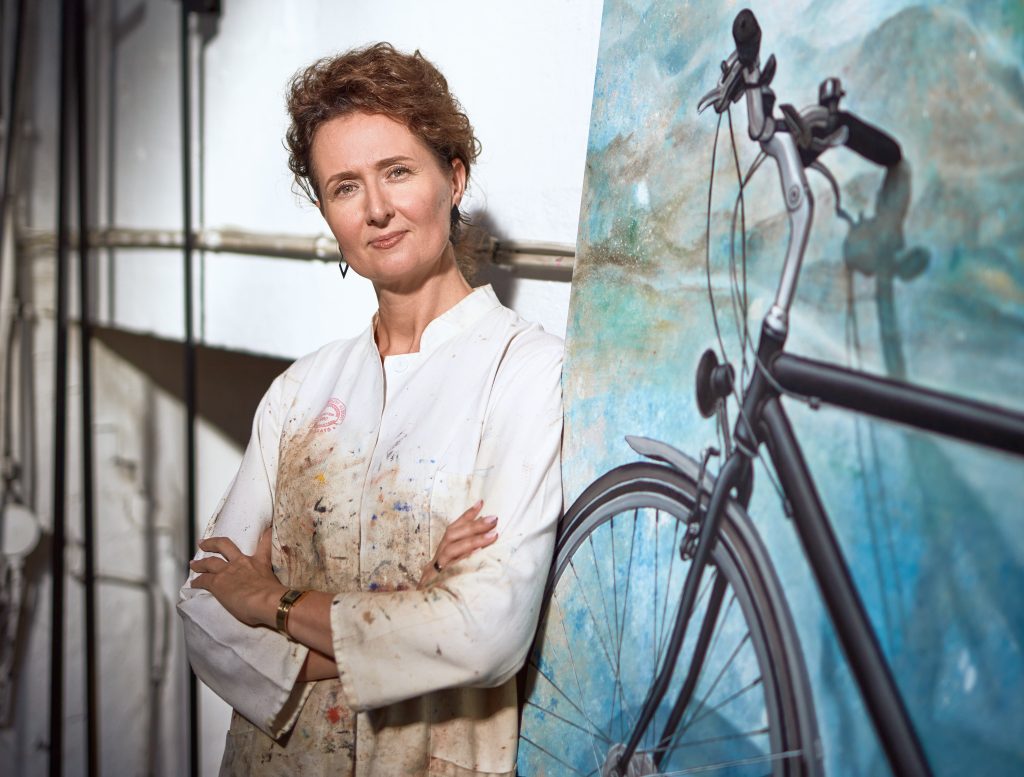
“It was the 10-year anniversary [of the prize] and they joined the photography and artist prize, but they also had a section for the greatest discovery – and it was me!” she laughs. “Not just me, of course, but I’m very proud.”
It’s an honour Boda can add to her ever-growing list of awards: in 2023, she won the VAA International Exhibition and Scholarship Award (her proudest achievement, she tells me); and nine years prior the Podmaniczky-prize, which recognises Hungarians preserving and promoting architectural heritage.
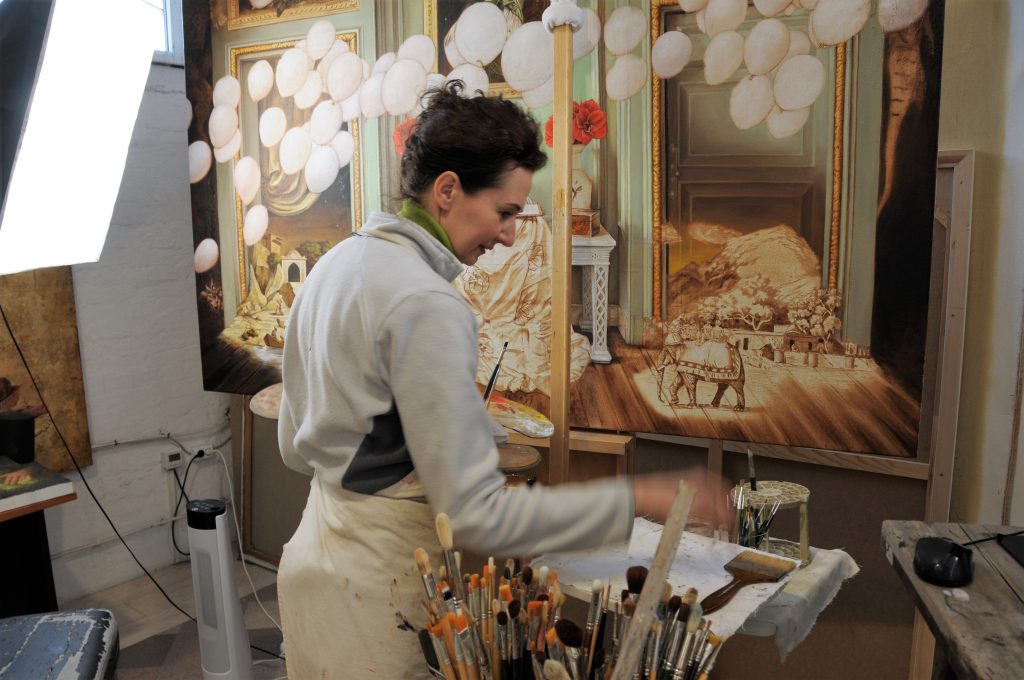
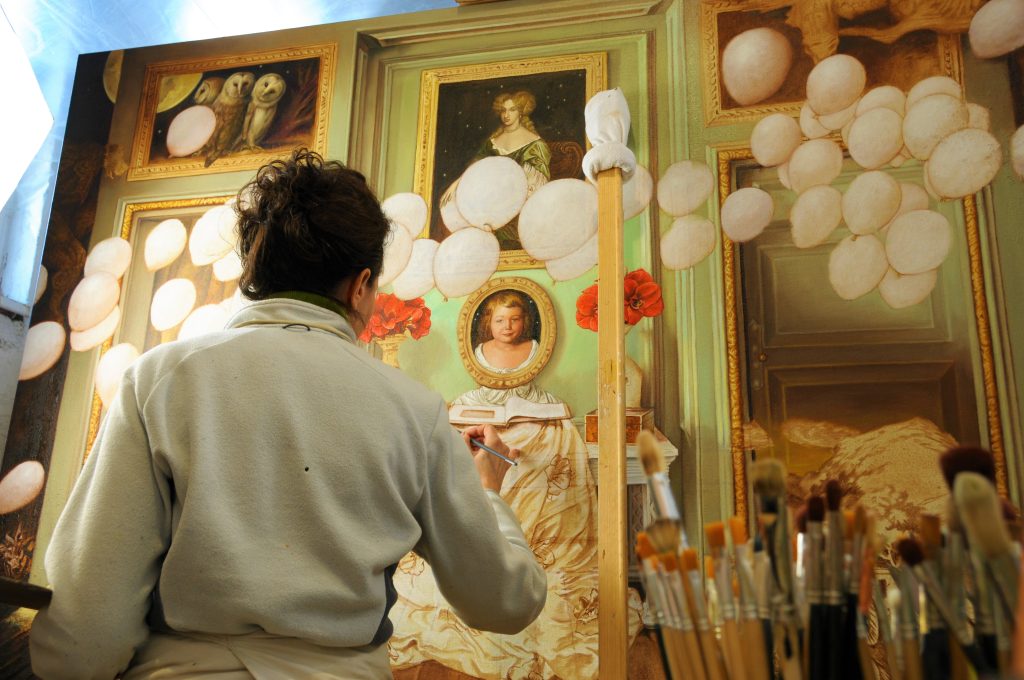
Despite her success over the weekend, there’s no rest from painting. She’s calling me from her laptop in her studio in Budapest; various artworks I’d researched beforehand were now peeping into view from the sides of my screen. When she spots my nosiness, Boda offers me a virtual tour.
“It’s a beautiful space, it has two windows, an eastern and a western. It’s an old industrial building – 600 square metres that I share with nine other artists.” It is indeed gorgeous: natural light floods in, illuminating a myriad of artworks of various sizes, from the small to gigantuan dotted around the studio.
But Boda hasn’t always lived the romanticised artist life. Born in Hungary, her family wanted her to go into medicine. “My grandma used to tell me that if I became a doctor, I could have a housemaid,” Boda recalls. “We used to live in the village, and the only woman with a housemaid was a doctor and all the other women were envious because they had to do housework and she did not.”
However, it’s clear Boda was drawn to the visual arts early on. “One of my earliest memories is of me sitting in a chair, drawing. It was so high my feet couldn’t touch the floor.” Both her parents suffered from hearing loss, so Boda’s home life was slightly unconventional compared to others. “I grew up in a very silent house. We didn’t have radio or musical instruments, so my only entertainment was reading books, drawing and painting.”
When speaking about her upbringing, it seems Boda’s grandmother played an important role in her life. “My grandma was a very strong woman. She worked as a shop assistant and then her son [Boda’s father] was born and he contracted meningitis when he was nine months old. He was born after the Second World War, in 1946, in Hungary so there was no medicine in the country. It had run out of penicillin so they couldn’t cure him and that’s how he lost his hearing.
“But my grandma just didn’t give up. She travelled from doctor to doctor, but no one could help him. So my grandma thought doctors were gods and that’s why she wanted me [to become one], as the oldest grandkid.”
Boda’s father was a car mechanic and her mother a seamstress. “We were a pretty simple family, we didn’t have a TV, and we didn’t have picture books so my imaginary skills developed very well,” she says.
Boda later went to medical school. As someone inherently creative, did she find that time stifling? “I had no problem with my medical studies. At school, I loved chemistry, biology, mathematics, languages, everything. I was like a Renaissance kid.” She graduated summa cum laude and became an obstetrician and gynaecologist.


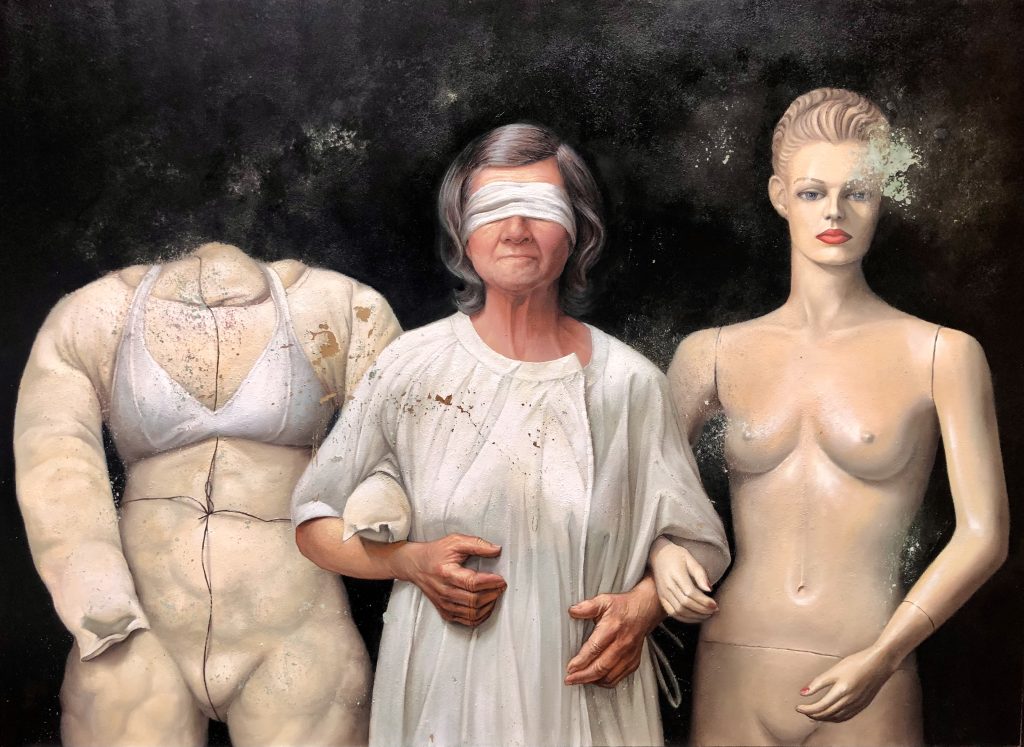

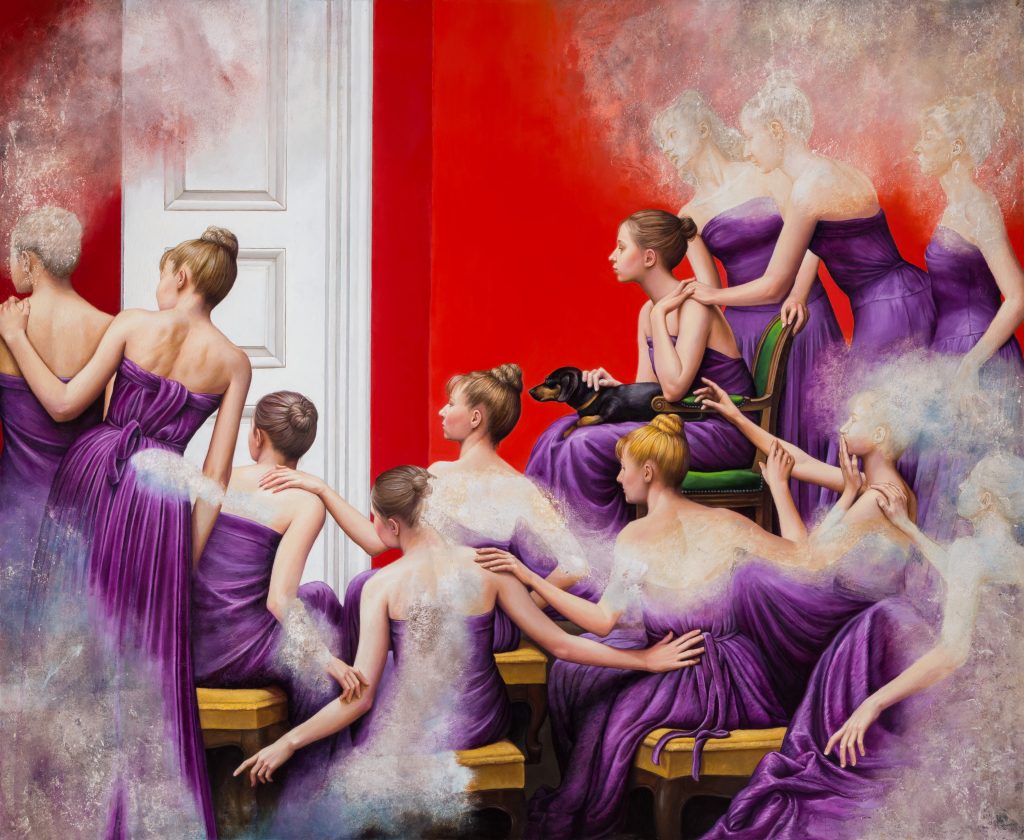



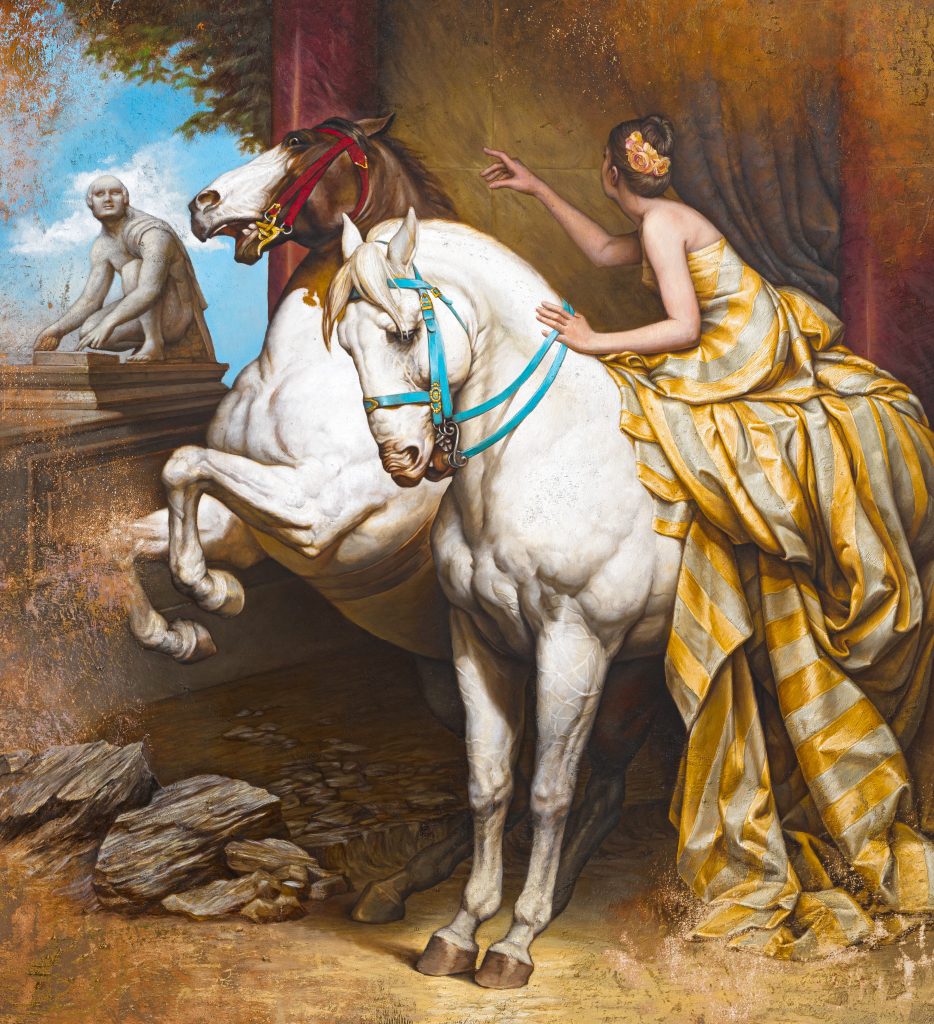
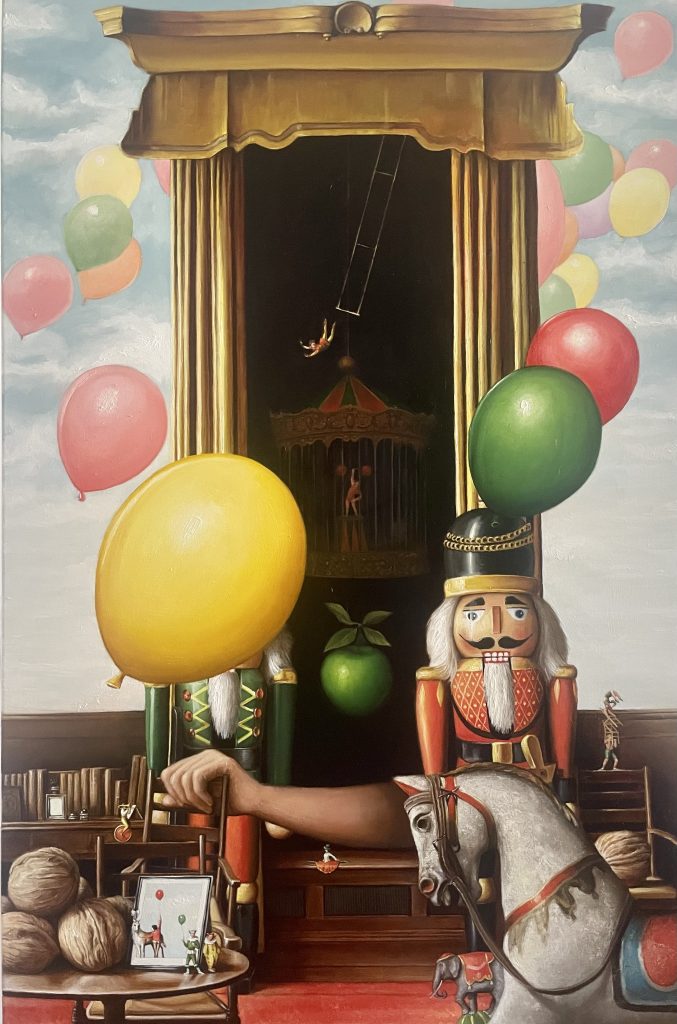
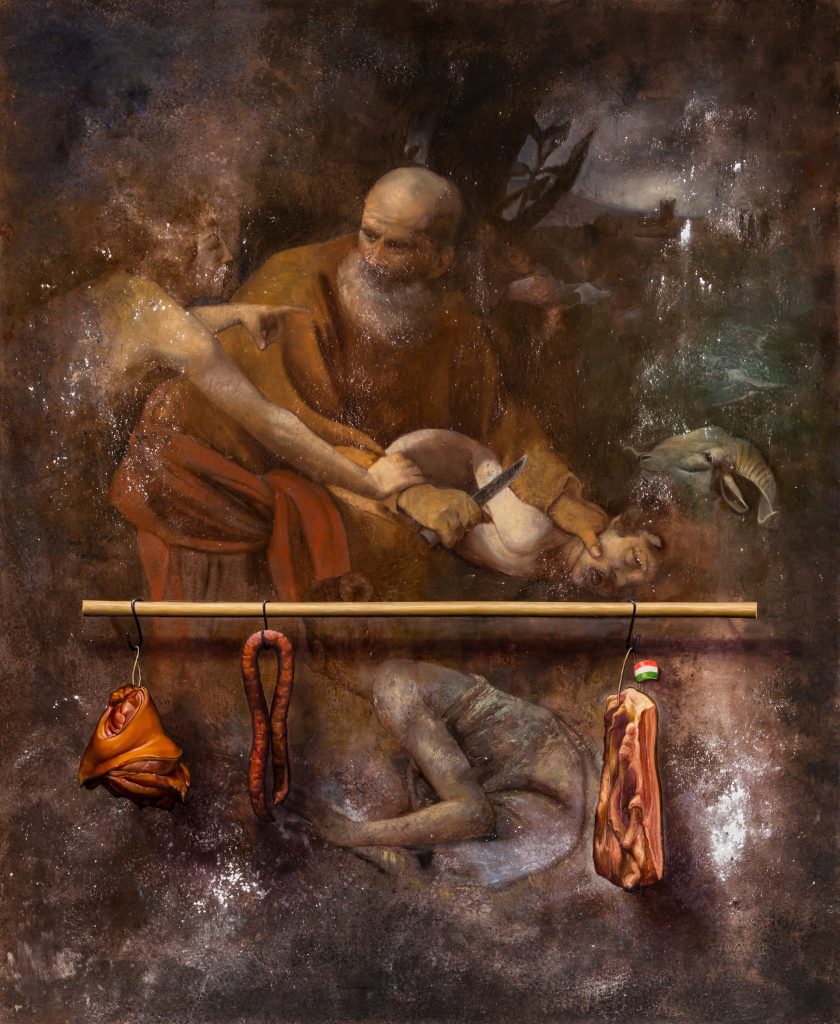

“I went to art school when I finished my day shift; I even exhibited during my medical school years. I always did everything in parallel with each other.”
So when was the shift toward art? “When I turned 30 and my two daughters were born in 2002 and 2005, I realised I didn’t have time [to do everything]. I cannot be a mum of two, a doctor and an artist at the same time. So I talked to my husband about the future and I knew I always wanted to be an artist.
“I restarted my life at 32 from ground zero. I applied to the Academy of Fine Arts in Budapest and I was studying with 18-year-olds. Can you imagine? I was 32 and the rest of the class was 18, 19, 20. I can’t say I enjoyed it but it was a very interesting experience.
“After three years [at the Academy], I went to work in private studios with other artists for 10 years. Now, I’ve been a full-time artist for four years. And I work more [than when I was a gynaecologist] but it doesn’t feel like work.”
How does she come up with ideas for her work? “I joke that my ideas come when I have a shower,” she chuckles. “But it’s true, because they don’t just come [into my head]. They come continuously.
Behind Boda is one of her paintings, Black Iris. It depicts a regular hallway with a grand white staircase at the back, but cascading down the stairs is black drapery, snaking itself around like smoke.
“I painted this when the Ukrainian war broke out, and I was thinking about how the bomb is the worst form of warfare because you cannot escape it,” she explains. “The black drapery represents these things – though people tell me it reminds them of Dementors from the Harry Potter movies…
“I also heard a story of a Ukrainian pianist whose house was destroyed, except for a room which had her piano in it. Then she played her piano among the ruins. So I used the piano as a symbol of human culture. And on top of the piano I put the symbols of the five main religions, and family photos around the room. I think if there’s war, you can find hope in human culture, your family, your religion.
“Then I included these black iris flowers – they represent hope.”
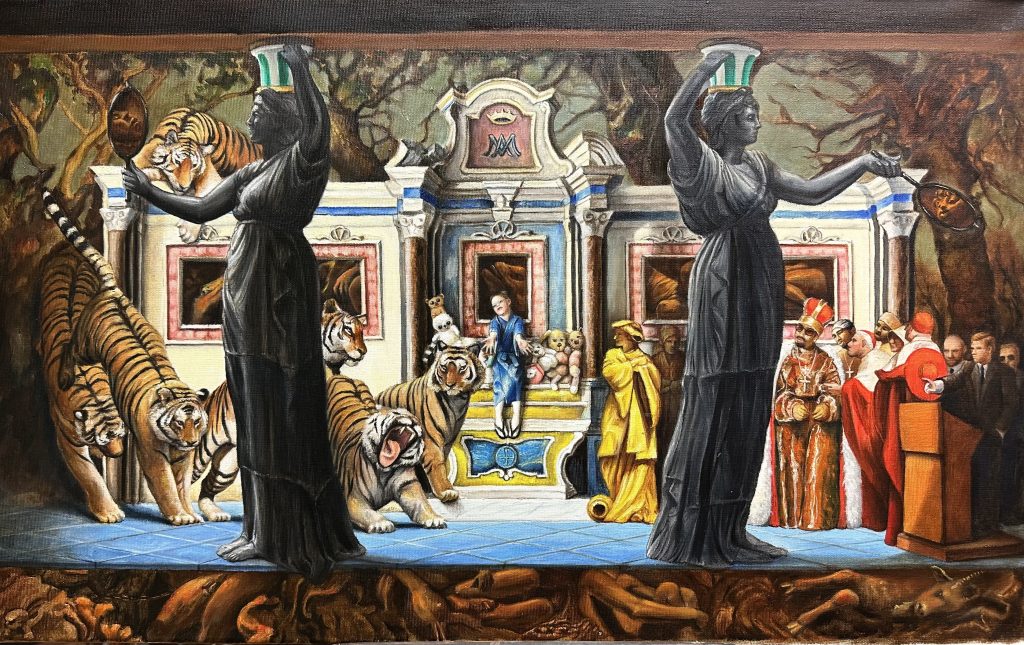
Hope is the central message in her works, Boda tells me. She proceeds to show me a painting she’s working on at the moment about paedophilia. It’s a colossal work: some of it has been painted, other details sketched. There’s a mix of tigers, toys and well-known figures.
“The right side of the painting is going to be the hopeful side, the tigers represent all the people who protect children. The centre is about the children themselves. Then on the left you have the bad guys.” It’s a very powerful image. “I hope it will have some effect, you can never be sure but we always hope.”
There’s a warmth to Boda who, for someone that insists her English isn’t very good, speaks eloquently with me on meaty topics from how to paint flying drapery to the role of religion in modern art. “[Nowadays] we lack a belief in God. In medieval times, it was totally normal for people to spend hundreds of years building a cathedral and nobody thought ‘what a stupid idea because not even my grandchildren will see it finished’. But they worked for something higher.
“Then in the 19th century, when the concept of a god started to crumble, I think that’s when art began to deteriorate. We don’t fight for a common purpose anymore. We just do our jobs and we’re not interested in creating something fascinating.”

I wanted to spend the entire afternoon discussing art, culture and history with Boda; chatting for over an hour, I almost forgot we weren’t in the same room. Our conversation wraps up with a brief discussion on artificial intelligence, something Boda isn’t feeling hopeful about. “I’m often asked if my paintings are made with AI and I tell them no, it’s made with NI – natural intelligence,” she laughs. And with that, she’s back to painting in her studio, tackling tech bros and modern injustices one masterpiece at a time.


