


Share
by anna jane begley
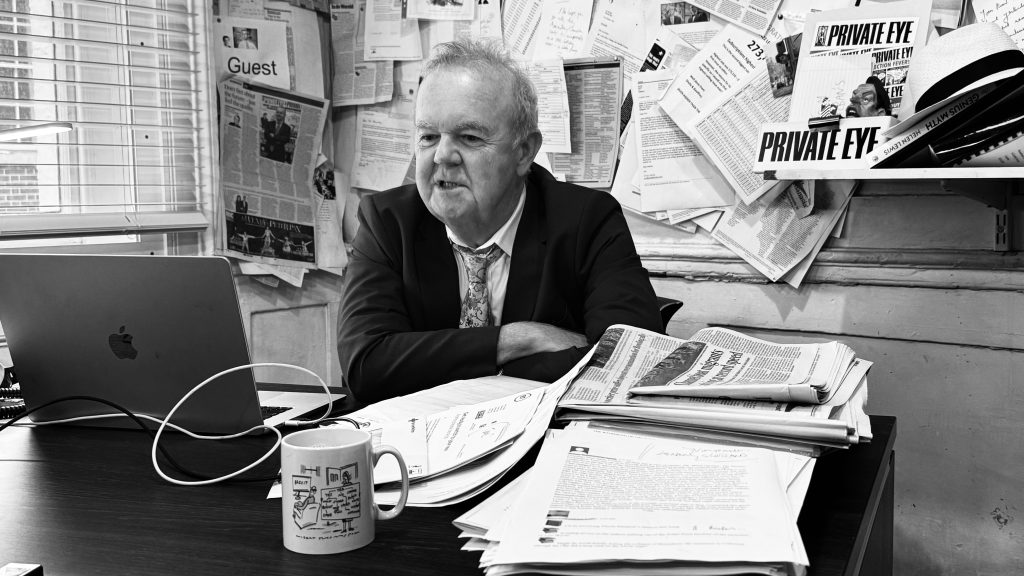
Sitting opposite Ian Hislop in his Private Eye office in London is a pinch-me moment for any aspiring journalist. The editor, satirist and writer is something of a national treasure in the UK, revered for his nuanced views, quick wit and searing jabs toward some of the most prolific people in the news today, from Elon Musk and Donald Trump to Gary Neville and Dominic Cummings.

The editor of the political satire magazine Private Eye since 1986, Hislop has also written comedy series My Dad’s the Prime Minister and Spitting Image among others, alongside his friend and colleague Nick Newman. For 35 years, he has been a team captain opposite Paul Merton on the BBC show Have I Got News For You. One of my earliest encounters with Hislop’s work was in fact at the British Museum, where he curated the 2018 exhibition I Object: Ian Hislop’s Search for Dissent, a collection of artifacts dating from the 6th century BC to present day that explore dissent, subversion and satire across continents.

If it isn’t obvious already, Hislop is one of the leading figures in the world of satire, and has regularly defended it as a way to challenge those in power and hold them to account. But despite his hefty reputation, Hislop is disarmingly down-to-earth – there are magazine proofs, old Private Eye editions, and various newspapers strewn on top of desks, shelves and cabinets around the office, like being in someone’s home (or my home, at least).
Happy to discuss any question thrown his way, we chatted about everything Starmer, school, Have I Got News For You, and what young people – and ancient Romans – get wrong about satire.
How old were you when you knew you wanted to be a journalist? Was it when you went to university or from a young age?
We had a formal school magazine, where you were allowed to write pieces in it. So some friends and I started writing some slightly sillier stuff for the magazine that wasn’t a report about the under-15 hockey. That was very good fun. And, I did a lot of reviews and sketches with friends.
I had a completely brilliant English teacher who directed plays, edited magazines, and was an inspiration. He taught me A-level English, but he also ended up a friend. A lot of people have an inspiring teacher somewhere in the background, and he was mine. Colin Temblett-Wood – he was a great man.
At university, you switched from studying PPE [Philosophy, Politics and Economics] to English. Why was that?
Because I had a vision of everyone who’d ever read PPE being useless! In those days, you had to take an actual exam to get in. It was a competitive exam. And I took maths as well as English because it was just something I could do and I thought, if I can do maths, I should do some economics. And then I did the reading before I went to university, and I thought I actually want to read English.
My time was fantastic, just reading anyone who’d ever been funny was essentially my reading list at university. I read Oscar Wilde and Bernard Shaw, I read the Restoration poet [William] Congreve. And I read all the satirists. It was an incredible privilege and I just really enjoyed it – which you’re not meant to say.

Do you feel reading English sets you up better to be a political satirist than a more ‘serious’ subject such as PPE?
I think almost any of those arts degrees are good because they teach you how to question, to analyse and to write if you want to write. So yes, I think it was good, but then I’d quite like to have read history. In retrospect, I think I’d have enjoyed that.
And while you were at university, you relaunched a satire magazine called Passing Wind. Out of all the student newspapers and magazines at Oxford, why did you feel you needed to write and edit that one in particular?
Because of my friend Nick Newman, who’s now a cartoonist, and The Sunday Times cartoonist. I wrote Spitting Image with him, and I’ve written plays with him. We were friends together at school, though he was a bit older.
He’d set this magazine up, and then it had folded by the time I got to Oxford. So there was this title knocking about, and Nick had managed to lose quite a lot of money on it, and he said ‘look, I’ll sell you the title’. I didn’t have any money, but my tutorial partner was an old Etonian who had a great deal of money. And I thought, basically it was his job to give me all his money and buy the magazine, which he did. So I then ran it. I did pay it back eventually. But I ran it and it was just really, really good fun.
You wrote a bit for Private Eye while at uni. then became its editor not too long after, right?
I wrote a piece just before my finals, Room of My Own. [It was in] very bad taste about the [IRA] hunger strike, and I remember getting paid from it, and I just couldn’t believe it. I took my finals, and I got another piece in afterwards. And I thought, this is marvellous. I must do this. So it was a couple of years after that, I came out of university in 1983 and I hung around the office, and they said, do this, that and the other.
About three years later, in 1986, my predecessor, Richard Ingrams, decided he just had enough and he announced he was going, and said would you like to be editor – which, in retrospect, is sort of nuts. But I am incredibly grateful to him. And because I was in my 20s, I said, yeah, I’ll do that. No problem. Now I look back and think, what were you doing?

Was it unusual to be the editor of Private Eye in your 20s?
Richard had been editor when he was 25 I think, him and his mates had set it up. Patterns do repeat themselves. So I don’t think they thought there was anything very odd about me doing it. There were the middle aged people in this office, many of whom said they didn’t think it was a great idea. But I got away with it.
Private Eye is almost exclusively in print, though I know you have a podcast now as well. In an age where every paper wants to transition to digital, why is it so important to stay in print?
I made the decision ages ago, and people have always said you’re mad, but I’ve always thought there’s something very special about print, the experience of reading print. If you have drawings and cartoons like we do, they’re much better in print.
I also like the serendipitous experience of reading a paper or reading a magazine. You start over here and then you read over there. You’re neither being sent there by an algorithm nor just finding what you like. And the other thing is – and this isn’t great foresight – I just always thought journalism is quite difficult to do well, and I think you should pay people. And people said, why don’t you give away all your content for free? And I go, no, I’ve got so many people working, you’ve got amazing stories. Three quid is amazing value, you should pay for that.
I’m sure when I go and someone else takes over, everything may change, but I’m committed to print. We sold 230,000 copies of the last issue. It isn’t a given fact that no one buys newsprint.
I was reading somewhere how a lot of political satire doesn’t work in the world we’re currently in, because the world itself is becoming more satirical. It’s difficult to make fun of something that’s already absurd. As editor of Private Eye and as someone who has written for satire shows, I wondered what you thought the future holds for the genre?
I don’t buy that. I think people tend to write that when they’re younger, and you think, well, the world’s so mad now there’s nothing to say.
I read a lot of stuff at university, and there’s a wonderful quote from someone who says, satire is finished. The world we live in is too mad. And the person who wrote it was a Roman called Juvenal writing in 79AD. And I think, okay, this has been said before. He said the emperors are too crazy, [as is] the way the world works.
He also sat around Rome and said, have you seen this city? It’s just full of foreigners, where have all the Romans gone, the place is full of people from the Empire. What are they doing here? Life does repeat itself.
Just saying Trump is orange and has got silly hair, it’s quite good to start with, but after a bit you have to go a bit deeper. The thing that really annoys Trump – which everyone found out very late – is saying, remember, he was hiding his tax returns, and the reason he was hiding them is because he didn’t pay any tax, he didn’t make any money because he’s a rubbish businessman. He got really, really cross about that. So you have to find out what really hurts, what damages people. Satire has to work a bit harder, but satire shouldn’t say, ‘oh, it’s impossible now’.

On the opposite end of the spectrum to Trump, you have Starmer who is seen as a boring figure. Is he easy to make fun of?
I think people voted for Keir in the hope that he would be boring and competent and pragmatic, and he’s turned out not to be those things. He’s turned out to be inexplicable and stubborn; having no idea how to make things happen or how to make people go with you, how to create a consensus and go with it, and how to explain what you’re doing.
I thought it would be quite an odd transition. I thought, what would we write about? And then you find out his first idea is [to cut] the winter fuel benefit. And you think, this is inexplicable.
I get people my age and on my income, we don’t need fuel benefits. You can explain that to the public, they’d be very happy. But to turn that into a widespread perception that you’re making old ladies shiver to death is incompetence. The message didn’t come across. And the inheritance tax on farmland – what he wanted to do was stop people trying to avoid tax. And what he ended up doing was getting lots and lots of mid-range farmers thinking they’re going to lose their farms. The failure to prosecute the aims you start off with is sort of extraordinary, really.
You’ve also got the state of policing – one of your readers was arrested for holding up a Private Eye cartoon. It made me think of your infamous quote ‘if this is justice, I’m a banana’. Are you still a banana?
I love the idea that this will go down as one of my great quotes, because I came out of court and I was really cross and there were all these cameras, and I said, ‘well, look, if this is justice’ and then I literally couldn’t think of anything so I said the first thing that came into my head, which doesn’t make a lot of sense.

But the great thing about this bloke was he was just so wonderfully British. I saw him arrested, and I thought, God, I wonder what he’d be like and of course, he’d never been arrested before. He’s a retired headmaster. He was incredibly nice, incredibly funny. He said, ‘Yes, yes, the police don’t really do nuance, do they?’ And I thought he was great. He’s one of those extremely well meaning older people.
I love the idea that [the government] thinks lots of teenagers have been radicalised. I think lots of retired people are radicalised by going on the internet, and they’re all spending their retirement going on demos. And you see commenters in The Daily Mail saying they’re extremists. No, they’re not extremists. They tend to be vicars, nice elderly people.
[The reader who was arrested] said, ‘well I’m Palestine Solidarity. I’m not Palestine Action’. They’re very well informed. Keir Starmer ran the DPP. He should know that if you put in a policing order that’s a bit vague on supporting Palestine Action – I get it, crossing a barbed wire and taking a sledgehammer to the fan of an aircraft, that’s not good – but it’s not terrorism. And saying ‘I support Palestine’, that isn’t terrorism either.
That’s obviously an issue for the BBC as well at the moment. It’s under a lot of fire about political balance and not being Left or Right, not offending certain groups. What do you think its future is?
I’m very keen on the BBC, not just because I’ve worked for them in various guises, but I’ve also worked for Channel Four, and indeed, almost anyone will pay, let’s be honest! I read the newspapers and one day it’s ‘the BBC is pro-Israel’ and I think, what, with Jeremy Bowen and Lucy Doucet? They seem to be doing pretty good, I don’t think this is pro-Israel. And then the other day, it’s ‘they’re incredibly anti-Israel’. I think they’re doing their best, they make terrible mistakes and get clobbered for it, and I’ve been involved in some of the clobbering, but the attempt to be balanced, I think, is good.
Jeremy Paxman, who was a terrific journalist and broadcaster, said there’s no obligation to be balanced between truth and lies. But that isn’t the job.
Which newspaper or site do you read other than Private Eye? And was there one you were loyal to when you were younger?
They were very keen when I was in sixth form that you should read a newspaper. And they had The Times and The Telegraph, it was very nerdy and pretentious but some of us read the papers in the morning.

I still read most of them on a daily basis and I read various stuff online. I read Haaretz most days, which is actually a better source about Israel than most of our press. The Indy is very good for condensed [pieces] and they’re very good at brief analysis.
You’re known for calling out people when they’re being hypocritical, particularly on Have I Got News For You. Which guest ruffled your feathers the most?
I always hope I’m ruffling their feathers. One of the ones I enjoyed most was having Alistair Campbell on, because he’s so used to dominating the agenda, to have him in a situation where I could just bring up Iraq, and then he’d say, we’ve had enough of that. And then I’d bring it up again, and then again. And he’d say, I’m in the chair, and you go, yeah, but I don’t care, because this is our show!
Johnny Mercer, that was fun. And Conrad Black – he came back to London just to say, look, I’ve been in jail, but I’m innocent. I just kept saying, but you’re not. You’ve been in jail. That sort of thing is enormous fun.

And any favourite guests?
My favourite guest was Captain Kirk, William Shatner. He was hysterical. He didn’t know who I was. He had no idea who any of the people on the show were or what the questions were about. And he sang, and he managed to libel an entire town in Cornwall, which he said was full of prostitutes on no basis at all. He just thought it might be. And I said, why did you agree to do this show? And he said, oh, my wife’s buying horses in Spain, and I thought I could come over and cover some of the costs for Mrs Shatner. Anyway, it’s not a very political or very high brow answer. I’m afraid it is the truth.
Thank you so much for your time, Ian. I had one final question – what advice would you give aspiring journalists today?
It’s really tough at the moment, and there are fewer opportunities. People have to be much more innovative, and they have to go on Substack and build their own brand, and have to do all this stuff, which I know is really hard.
I still think the journalism course is good, like the one at City [University, London], they get people jobs. And the three-month PA [Press Association] course. They’re good because you meet lots of other people, and so many people build up those networks. It’s networking. These are your contemporaries. You need them. So I think you need to build that up.

Part of being a journalist is being interested in the rest of the world. There’s a lot of journalism that says, I want to write about myself, what I’m doing and what I’m feeling, what my cats are like. Don’t tell me about yourself – you may be lovely, but I don’t care. You’re meant to be interested in other people. If you want [people to be interested in you], become an actor. There’s plenty of other jobs! [Being a journalist] is different, and you need to be interested, you need to be engaged.
pictures by /ash
1 Comment
Leave a Comment


Great interview and pics. Really got a sense of Hislop as a journalist and a person and wise words of advice from him for young journos.